Tombstone of Ludwig Boltzmann in Vienna, showing his fundamental formula S = k log W, where S is the entropy, k is Boltzmann’s constant, and W is the number of available microstates.
Some consider S = k ln W to be easily the second most important formula of physics , next to E = mc² or at par with it. This formula is sometime called ” Boltzmann formula” (or Boltzmann entropy formula) and entropy calculated from this formula is sometimes called Boltzmann entropy.
Entropy is the tendency of stuff to move to chaos. Things just love disorder, chaos, drama; whatever you call it.
“the second law of thermodynamics says that entropy always increases with time”
Tendency of everything in the universe to move from order to disorder.
possibilities for disorder are more than those of order…
There’s only one way for order but a huge number of ways for out of order or disorder… Total mess is much more likely
Some entropic basis to this.. There are many more ways to fail than to succeed
Way overtime where we have a far higher probability of random permutations
Disorder/ probability always wins
tends towards disorder.
The ultimate source of order at low entropy must be the very beginning of the universe, THE BIG BANG..
Everything after this increases in disorder as the universe expanses
The explosive force of the Big Bang set space hurtling outward and as a result the universe is still expanding today. The more it expands the higher the entropy
Entropy set in motion billions of years ago.
The Arrow of time.
All the changes from the formation of stars to our lives is all little epiphenomena surfaces riding the wave of increasing disorganization that defines the difference between the past and the future
The concept of entropy is famously confusing, and the definition has evolved over time. Essentially, Entropy is a thermodynamic property that refers to the degree of disorder or randomness in a system. It can be summed up as the description of a system’s progression from order to disorder.
The second law of thermodynamics states that entropy can only remain constant or increase within a closed system —
a system cannot move from high entropy to low entropy without outside interference. A common example that demonstrates entropy is an ice cube melting — the cube is in a state of low entropy, but as it melts and disorder grows, entropy increases.
Many physicists think that the universe itself is in a constant state of increasing entropy. When the Big Bang occurred, the universe was in a state of low entropy, and as it continues to gradually spread out, it is growing into a higher entropy system.
There are two ways things handle time. First, there is aging and perishability: things die because they have a biological clock, what we call senescence. Second, there is hazard, the rate of accidents. What we witness in physical life is the combination of the two: when you are old and fragile, you don’t handle accidents very well. These accidents don’t have to be external, like falling from a ladder or being attacked by a buffalo; they can also be internal, from random malfunctioning of your organs or circulation
The arrow of time expresses the fact that in the world about us the past is distinctly different from the future. Milk spills but doesn’t unspill; eggs splatter but do not unsplatter; waves break but do not unbreak; we always grow older, never younger. These processes all move in one direction in time – they are called “time-irreversible” and define the arrow of time.
Realize the relative brevity of time
Provide context to the relative triviality of so many things most people worry about
A trillionth of a trillionth of a trillionth of a second old
Stupendous numbers
Sail through the curtains that conceal the beginnings of time
Desire leaps out of the abyss and in that very desire we find the beginning of nature
Out of nothing, in an instant, everything, an infinite cosmic orgy of matter and energy rubbing, bumping and grinding together. Collisions of heavenly bodies.
In a “typical” universe everything would be in equilibrium.
It is the initial state of the universe plus the dynamics which determines what is happening at present. Conversely, we can deduce information about the initial state from what we observe now. As put by Feynman, Feynman, et al. (1967) “It is necessary to add to the physical laws the hypothesis that in the past the universe was more ordered, in the technical sense, [i.e. low ] than it is today..”
A course of reverse entropy..
From ruins to civiization
Think of it as the neutral point on a pH chart
From the habitation to the inhabitation of the Olduvai Gorge
Ruins of ancient civilizations from 23 BC Kush to Roman Empire’s sackings and sandstone rotting
Entropy is not a process, but a a quantity that measures how “random” or
“disordered” a system is. The Second Law of Thermodynamics says that entropy
only ever increases spontaneously.
The laws of thermodynamics aren’t fundamental
laws of nature the way that, say, gravity and electromagnetism are. They’re
emergent behaviors — statistical descriptions of what happens when very large
numbers of particles interact with one another.
1. Evolution is not what you think it is. Organisms evolve biodiversity,
sometimes cataclysmicly through events such as radiation, comets, etc.
and sometimes through mutation, cancerous and epigenetic factors
causing new genotypes that survive. This represents a change that
carries through reproduction of a species, but that’s all.
2. Survival of the fittest is not what you think it is: this is circular
‘reasoning’ that is the tautology stating that things which survive are
adaptive, and things that are adaptive survive. Features happen to
survive that may be causally completely unlinked to adaptation.
3. Biodiversity IS a thing, and it follows the rules of thermodynamics and
entropy. We are not more ordered than yesterday, despite your perception.
Entropy is the engine behind all work in the Universe. The movement from order to disorder, that gradient and the inexorable movement of systems from structure to random unordered homogeneity is where we all live, and where any ordered systems that build and accomplish anything must exist. We would not be able to lay one brick upon another, or build one cell from another if we were not awash in the entropy flow pouring from the Sun, from which we borrow a short reprieve for our collection of atoms.
There has never been a chemical reaction that occurs in organisms that violates the 2nd Law. One point to be made about that is that the 2nd Law, as objectively formulated, is about closed systems. If you just look at the material that stays with a plant during chemical reactions, you’re not dealing with a closed system. Plants release oxygen and at night they even release some carbon dioxide. On the average they are at higher temperatures than their surrounds, and this means that they are constantly radiating energy at moderate to high rates mostly infrared radiation. All of this disperses energy, just as expected from the 2nd Law.
The structures built in plants and animals are built using coded instructions that are in DNA and also in cells in other ways. The use of code to direct assembly can’t violate the 2nd Law. If the code is reproduced perfectly, there is no change in information. If it is not, as is often the case in reproduction, there is an increase in information entropy as expected.
Entropy only needs to increase in an isolated system. Systems can self-organize (decreasing entropy locally), so long as the price is paid elsewhere (increasing entropy globally).
N.B. The second law of thermodynamics actually says that
The expectation value of entropy is allowed to stay constant.
Yes, a system does tend toward disorder, which is its lowest “energy state,” so how could evolution go in the other direction? The reason is simple: it’s because the Sun is always injecting new energy into the system, and it does it in a way that is harnessed by the biochemistry and ecosystem of life. The Earth is an open system, not a closed one.
New energy in the form of sunlight is the first step of an “energy gradient” that flows through the ecosystem of life at multiple levels. This energy gradient drives the biochemistry of evolution in the same way that water flowing downhill drives a waterwheel, or burning coal heats water to drive a steam engine. At the level of chemistry, the energy flow that drives evolution looks like this: sunlight -> photosynthesis -> ATP production -> complex molecule construction > food -> growth and reproduction (+ mutation) -> evolution. And the level of the food chain, it works like this: sunlight -> plant growth -> animal growth and reproduction -> animal evolution -> humans If the Sun were to “turn off” tomorrow, then evolution would come to a stop and life on earth would freeze over and decay into a lifeless rock.
Because of…. well…
Stool has very high entropy, which allows you to decrease yours… Only the total entropy needs to increase.
an
organism in thermodynamic equilibrium with its environment is a dead organism. Most prominent of these tricks to avoid equilibrium is the act of feeding and subsequent excretion.
To summarize: Most “refutations” of the claimed contradiction between evolution by natural selection and the second law are simply wrong, and ignore the subtleties involved.
There has never been a chemical reaction that occurs in organisms that violates the 2nd Law. One point to be made about that is that the 2nd Law, as objectively formulated, is about closed systems. . Radiant energy comes to earth. This energy can be converted into all kinds of things. Some but not all can be converted into mechanical energy or into chemical
And most of that mass I ate, I released. I breathed out hot CO2 and water and got rid of other mass in the toilet (‘nuff said). Throughout that time, I radiated 37°C into the environment.
I might have been more complex or ordered but the world around me became less ordered.
In the larger evolutionary picture, life uses energy to control entropy – not stop it, but make it happen in some places and less in others. Plants take energy from the sun and use that energy to trap carbon and water to make sugars and more.
They can only this if sun shines on them. We use plant energy to grow. It all comes back to the constant supply of sunlight.
The alchemy symbol for entropy…
So, as a process of energy loss, it is difficult for me to point to a specific symbol
in the alchemy lists of symbols. Alchemy is a process of refinement. However,
for no good reason, I will choose sublimation, and the Zodiac symbol of Libra.
Energy drives life, the entropy is selected by life itself, its an effect, not a cause.
The entropy levels of life are subject to natural selection selected in the same way that any property it needs is optimised by natural selection. That is obvious, low entropy is too rigid, high entropy is too dynamic. You don’t need to introduce mysticism. Life is optimised on a regime of entropy fairly close to that of water.
Human progress is reliant on our greater understanding of the universe, on our capacity to embrace chaos and craft from it, something, a pattern, order, a narrative
Entropy stands tall and proud today, elevated into an immutable fact of existence. No matter how hard you try, you simply can’t escape the iron grip of its cold, relentless conclusion: In isolated systems, the entropy cannot decrease.
The second law is as certain as saying the odds of getting heads when you flip a coin is 50%.
This means that nature goes from order to disorder.
If you take the current state of any system and calculate all
possible next states, you will find that the vast majority of those states are less organized
As any system evolves through its state space it will seem to follow a course of increasing entropy. None the less, each state is chosen randomly. There is no commandment that says: Thou shalt not decrease entropy. It just so happens that less organized states are more common than more organized states. Still,
once in a great, Great, GREAT while, one of those next states will be more organized
A better question is ; Why do things move?
If you lived in a universe where entropy decreased, we would still ask why
something(entropy) is positive because you would have defined positive as
moving from disorder to order.
Entropy is degree of possible motions and exchange of energy in possible
space.
Will Heat flow from the cold to hot or hot to cold? You think about the chances
of either being so in our universe because there is no law that states that heat
must flow this way or that way.
There are simply, mathematically more chances of disorder and randomness
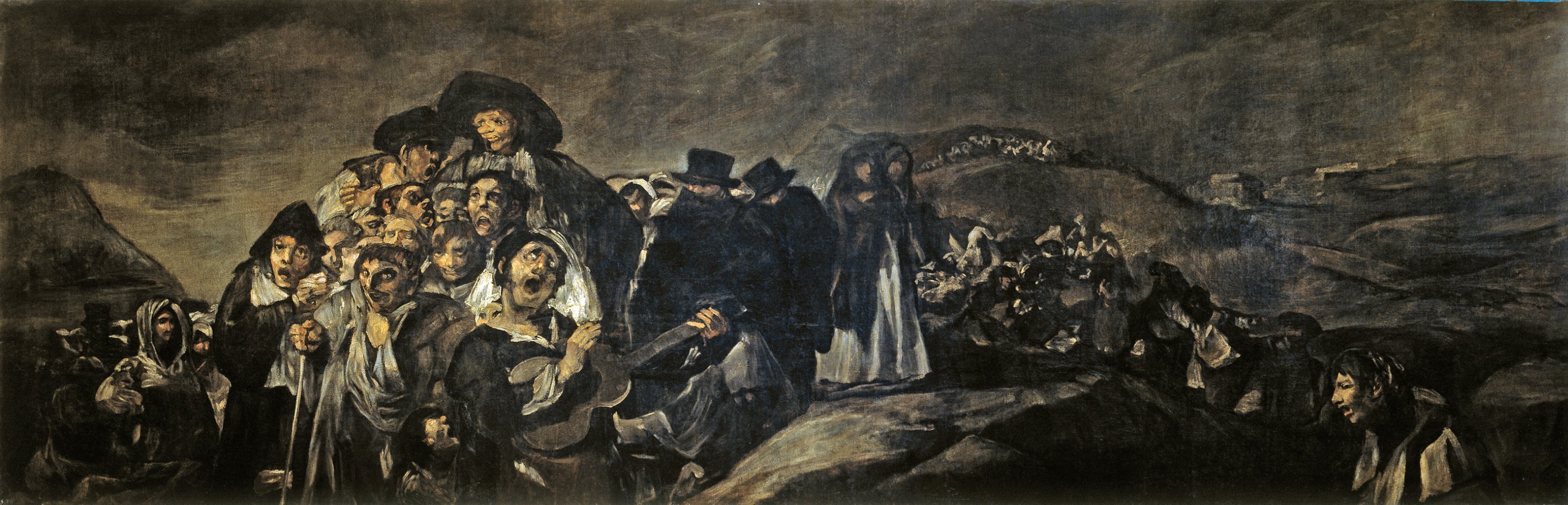
In 18th Century Europe the loss of faith in a divinely ordered world would lead one painter from the light into the dark.
In 1788, the Spanish court painter Francisco de Goya painted this,
the annual festival of San Isidro, Madrid’s Patron Saint
Airy with colour and light, its an exercise in a quintessential 18th Century occupation, the pursuit of Happiness. The heaviness of church and state are banished to the horizon above , while the people and their pets are dancing and drinking below. Night would never fall. But, it did
30 years later, Goya painted the same scene, the same day but the ordered world is now disordered, dancing instead to the tune of a mad man on a discordant guitar.
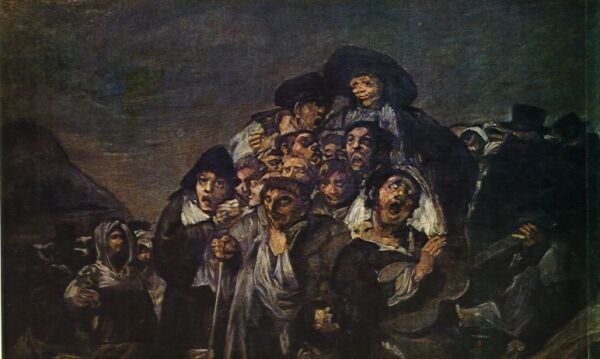
Someone had turned the lights out. In placebo of brightness and light the Festival of San Isidro, we have this the sky has turned to the colour of turpid sludge. In place of liveliness we have a rolling freakshow here, the great clowns of gibbering, the psychotic, the unhinged, glassy eyed and mouths opened.
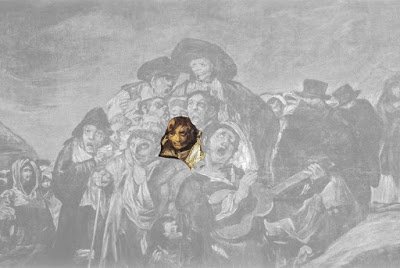
In a corner of the painting there is a figure seen in profound who seems to solemn everything in Goya’s head the figure has an open mouth, and that open mouth seems to be emitting a terrible howl of pain.
So how did Goya get from colour and life to this particular pit of sorrow?
The clue is in the painting. There in the centre of the clump of the crazed is the unmistakable face of Napoleon. The author of all this world of entropy. Between 1810 and 1820, Goya witnessed the violence unleashed by Napoleon’s invasion of Spain.
And in his 70s, Goya came to paint his black paintings.
The black paintings seem to me to be an endgame for Goya. Not just in his own light and career in his 70s but also his feeling about an endgame for art. The art that aspired through beauty.
As modern art progressed, the chaos menacing it only became more explicit and pronounced.
In Picasso’s paintings, the human being is broken into fragmented parts and then pieced together again in disjointed abstract and often hideous forms.
Picasso’s art no longer seeks the complete human being at all. Wrote Nikolai Berdyaev. It has lost the faculty of seeing things as wholes. It tears off one cover after another in order to lay bare the structure of nature and in doing so penetrates even further into the depths, disclosing images of things truly monstrous.
But the chaos of 19th Century art pales in comparison with it’s manifestations in the first half of the 20th Century.
In the movement of Surrealism, the chaotic is not only represented visually, but explicitly exalted as a principle of life.
Salvador Dali declared painting to be the “coloured instantaneous photography of concrete irrationality and the systemization of confusion.” Entities with no intrinsic connection to each other are brought together in a senseless embrace. A thing among things; dissolved in the sorrounding world of inanimate objects begin to penetrate the human form so that man and his incomparable personality are no longer entities at all.
American psychologist Rollo May once wrote – ‘Our age is one of transition, in which the normal channels for utilizing the daemonic are denied; and such ages tend to be times when the daemonic is expressed in its most destructive form
It may help to understand human fares to know that most of the great triumphs and tragedies of history are caused not by people being fundamentally good or fundamentally bad but by people being fundamentally people
Every human being coming into this world has to face birth, aging, illness and death; love, hatred, parting and separation e.t.c all kinds of sufferings
Even if one has temporal happiness or joy, it’s only like a dew drop, a lightning, a dream, or a shadow so evanescent, so non-attainable.
The fate of sadness and happiness, separation and union between birth and death.. The meaning of our existence.
It’s not all random though
Well, since the Big Bang set everything in motion, everything that happens in this universe has to be the way it is.
Its all just particles unfolding the way they are destined to.
It’s pretty depressing to think about it.
When we are creative, rather than responding to chaos and conflict with passivity and powerlessness, we react in a proactive manner by transforming our mind or giving form to some component in the external world to help us make sense of the chaos, cope with it and ultimately transcend it
Given the role of creativity in transforming chaos and conflict into order and form and feelings of powerlessness into power, the lack of a sufficient creative outlet in our life is a prime culprit for many of our personal problems
Yet as Pablo Picasso remarked, “Every act of creation is first of all an act of destruction.”
Whether we are creating a more powerful state of mind or something of extreme worth in the external world, we first need to clear away the old and obsolete in order to make way for the new.
And to help us engage in this creative destruction, the courage, assertiveness and energy which accompanies anger can prove indispensable.
Tapping into this passion as a stimulus for creativity and self transformation, Hence why in William Blake’s the Marriage of Heaven and He’ll, Satan is the symbol of creativity, activity, and energy struggling to be free.
We have devised intricate social rituals to maintain a common altruistic image behind which we hide the anger which dwells within and in so doing, we have made ourselves psychologically unstable and prone to psychosomatic disorders in storms of rage arising from our unconscious.
Our culture requires that we repress most of our anger and therefore, we are repressing most our creativity.
The need to be creative is not limited to artists or certain personality types, rather the necessity to be creative is called forth within us all whenever inner or outer conflicts and chaos manifest in our life.
The presence of conflict and chaos signifies the need for some sort of shift in our world view, ot change in our character or environment.
Anger can be the kind of passion of destruction required for any form of lasting and meaningful creating.
For if we can become more aware of and accepting of the anger within, we can use it to invigorate us, propel us creatively toward distant goals and transform us into a more self asserting and decisive individual.
As a species, in our finest form, we are all philosophers
In the most comprehensive sense of the term.
We have agency, our minds can change the world
All the encompassing ethos that shape everything
Perfect the individual
It is the great thing about Golden Ages; they’re very comforting.
We believe that if humanity was capable of wonderful things in the past
We can achieve them once again
Technologically, the world has changed immensely, but psychologically, Naah we haven’t made much of a stride
If the creations of Great Artists reveal the underlying psychological and spiritual atmosphere of the times then an honest survey of modern art must lead one to consider the possibility that modern civilization is suffering from a spiritual sickness. A deep existential loneliness an eruption of the demonic a negation of human nature and a fragmentation of the human form, a celebration of chaos and thus perhaps, even a sickness unto death.
Yet as Erich Newman points out, As children of the times, we must recognize that this sickness also lives within us,
But let us be careful, we are speaking of ourselves. If this art is degenerate, we too are degenerate, for innumerable individuals are suffering the same collapse of the cultural cannon, the same alienation, the same loneliness – the rising blackness with its shadow and devouring dragon. The disintegration and dissonance of this art are our own; to understand them is to understand ourselves.
Despite this grave diagnosis, there is room for hope. Since the beginning of the 19th Century, the chaos menacing the world has appeared to only grow stronger. But as the sickness which afflicts the modern world also exists within us, we have the power to heal it.
For most individuals, such healing cannot be achieved by a return to the past, the solutions offered by the Christian world view are no longer available to the individual who exists in a psychological sense at the precipice of the modern world.
Nor can psychological renewal be achieved by adhering to the contemporary world view and cultural cannon, if such a world view is corrupted as modern art seems to suggest.
Instead, renewal today seems to require what Nietzsche called a revaluation of values. We must become physicians of culture and not only diagnose the sickness of our age, but also heal the manifestations in ourselves. By discovering a new set of values and worldview which can reinstate the dignity and potential grandeur of the individual.
We must in the words of Nietzsche; “apply the knife vivisectionally to the chest of the very virtues of the time in order to know a new greatness of man… Anew untrodden way to his enhancement.”
For when a body is sick it is individual cells that heal it. And also too when a civilization is sick, it is up to individuals to heal themselves and in so doing contribute to the healing of the whole.
In reality (wrote Jung), only a change in the attitude of the individual can bring about a renewal in the spirit of nation’s. Everything begins with the individual.
As he further explains, the development of modern art with it’s seemingly nihilistic trend towards disintegration must be understood as the symptom and symbol of a mood of universal destruction and renewal that has set it’s Mark on our age.
The 15 billion years of cosmic evolution of hydrogen atoms
Stardust to consciousness
Embody the local eyes and organized collection of quadrillions of atoms
One species.. the discovery that there is order in the Universe. We speak for Earth
Obligation to the planet from which we spring
Idolize the exploits of it’s heroes
We have considered the destruction of worlds and the end of civilizations…. But there is another perspective by which to measure human endeavors
A way for the cosmos to know itself
In a decaying society, art, if it is truthful must also reflect decay,
And unless it wants to break faith with it’s special function, art must show the world as changeable,
And help to change it
~Ernst Fischer
There’s an expression, this planet used to be molten lava and today it sings opera. Where does that come from? The human capacity for art and literature and music and exploration, all the amazing things, miraculous things, they all come from inside human beings who had the time and the resources and the training and everything else that it takes to unleash that potential and most people have died with their music still inside them. And that’s been the case of humanity until now.
It is our fate to live during one of the most perilous and at the same time one of the most hopeful chapters in human history
The Age of Pisces is dying, and the figure of Jesus no longer serves as an example on how to lead our lives. We are in the early stages of Aquarius and still trying to figure out what it all means. Philosophically these are hard times, sort of like the saying, “Brother, can you spare a paradigm.” The Astrological Ages always involve a polarity between opposite signs-in this case, Aquarius and Leo. “Entropy” is a metaphor for the lower side of The Age of Society (Aquarius), while alchemy is our collective progress. The past few centuries have seen the great social and technological advances that are the hallmark of Aquarius, but they have been accompanied by cultural decay and a loss of symbolic meaning and true individuality. Instead we see a near obsession with superficial forms of self-expression (the lower side of Leo), which may be a reaction to the increasing uniformity and pervasive organization of Aquarius. Other cultures react against the impersonal, secular modernity of Aquarius with a fervent religious fundamentalism or blind loyalty to an undemocratic Leo-like leader; but in either case, resolving this dichotomy between Aquarius and Leo, society and the individual, is one of the keys to civilization’s future.
The increase in mental illnesses .. Testament to that fact
Dark Ages in between The Drama of Rome suggests civilization does not progress in a straight line towards prosperity/ law/ technology/ law/ technology. It shows us the picture of amazing things being achieved by the Greeks and the Romans and then those essentials being lost again
Civilization breaks down into epochs and disconnected cycles. At a given moment and within a given race a specific conception of the world and of life is affirmed from which follows a specific system of truths, principles understanding and realizations. A civilization springs up gradually reaches a culminating point, and then falls into darkness and more often than not disappears. A cycle has ended.
It is on the above basis that we have to understand the whole idea of Entropy. In a certain sense it can also be called chaos but completely disregarding all the present connotations such a term may evoke in our minds.
Empires rose and fell for 5000 years.
Civilizations vanish; mankind does not
If we go, we will almost
certainly take a lot of the “higher” forms of life down with us. Also, as James Lovelock reminds us in his
books, Gaia is not in the prime of her youth. As the sun continues getting hotter, a shock to the Earth
system that would have been shaken off during an earlier epoch could prove fatal. Are human beings
capable of delivering such a shock? I don’t know, but we have developed an extraordinary capacity for
violence, so I wouldn’t discount the possibility so easily.
The true danger of mass extinction is that we’ll have nowhere to sate our predatory instincts except on each other
“Violence, after all, is no mystery. It’s peace that’s the mystery. Violence is the default. It’s easy. It’s peace that’s difficult; learned, inculcated, earned.”
“Peace is an illusion, no matter how tranquil the world seems, peace doesn’t last long. Peace is a struggle against our very nature. A skin we sketch over the bone, muscle, and sinew of our own innate savagery.”
— season 1, episode 2 (“Fallen angel”)
In the deeper layers of our psyche exist prehistorical drives and impulses. Just as our bodies contain relics of earlier development stages.
Stretching back even to the reptilian age, so to our psyche contains within it’s depths primitive drives that stretch back into the pre-history of humanity.
Every human being, no matter how civilized and developed on the surface is still an animal and archaican within the depths of his being.
In these uncivilized layers
The Beast within _ potentially destructive inclinations which can overtake and possess the human being, Such as the drive to aggression and unbridled sexual lust
Seeing that our birth involved the blending of these two things.. the body, on the one hand, that we share with animals, and on the other hand rationality and intelligence, that we share with the gods.. most of us incline to this former relationship, wretched and dead though it is, while only a few to the one that is divine and blessed
Between the various orders of conciliating forces, exterior and interior, individual and cosmic, to the point of oneness in which the spirit can be vibrated efficiently and without hinderance
At the bottom of us really deep down there is of course something unteachable, some granite of spiritual fatum
Instead advocating repression of the beast within Explore and become familiar with these potentially destructive vestiges of the ancient past
Just as a raging river can be harnessed for it’s energy so too the uncivilized layers of the psyche of channelled and handled properly can vitalize life
The most shortsighted and pernicious way of thinking wants to make the great sources of energy, those wild torrents of the soul that often stream forth so dangerously and overwhelmingly, dry up altogether, instead of taking their power into service and economizing it
laws of the dialectical method. The first
dialectical law is the law of the unity and conflict of opposites. This states that the world, both social
and physical, is a paradoxical terrain characterised by a unity of contradictions, a unity of opposites.
For instance, in mathematics, we have the integral and the differential (plus and minus); in
chemistry, we have fusion and fission (combination and dissociation) of atoms; in mechanics, we
have action and reaction; in physics, we have positive and negative electricity by which we boil
water and freeze it.
Similarly, in the social world, we have the haves and have-nots; the rulers and the ruled; buying and
selling; in war, there is advance and retreat, victory and defeat. Even the Bible says in Galatians
Chapter 6 that the human being is a bundle of contradictions – the soul is always warring against the
flesh and vice versa. To fully understand phenomena, therefore, we must seek out their internal
contradictions.
That we live in entropic times isn’t lost on anyone, so it’s only befitting to assign a god to entropy
Nimrod The Son of Kush.. Bacchus
Grand Uncle of Heroic worship
An inviolable personality
The whom Providence had given so many myths
Sickening and fascinating at the same time
Whatever form it takes, the old gods are coming back to life again and nobody can see it
Everything is much more older than we think and everything old happens again
Whatever form it takes, the old gods are coming back to life again and nobody can see it
Golden Age Athens
Hardcore philosophy in Dionysiac environments
Dionysiac gift of wine that helps men think outside the box
Free Falls
For any sort of perception or creation to exist, a certain psychological precondition is essential ……… Intoxication
For sensible thought to flourish, drinking had to be tempered
The Greeks watered down their wine, acknowledging the dangers of excess
For them, the gifts of Dionysia were considered a burden for mankind as well as a joy
Dionysus… The god of many forms and inexpressible depths.
All of antiquity extolled Dionysus as the god who gave man wine. However, he was also known as the raving god whose presence makes man mad and incites him to savagery and even to lust for blood. He was the confidant and companion of the spirits of the dead. The flowers of spring bore with him too. The ivy, the pine, the fig tree were dear to him. Yet far above all these blessings in the natural world of vegetation stood the gift of the vine… Dionysus was the god of the most blessed ecstasy and the most enraptured love. But he was also the persecuted god, the suffering and dying god and all whom he loved, all who attended him, had to share his tragic fate
characterize Dionysus as the god of wine, rapture
(including the sexual kind), frenzy or – as it was referred to in ancient times – ecstasy
Bacchus … The god of ecstasy and wine… The god who blurred the boundaries between human and Divine, between women and men, between the wild and the tamed… The god who seemingly sat at the edges of society but arguably right at the very foundations of civilization itself worshipped by every class from Citizen to slave in heady orgiastic rituals.
ORGIASTIC RITUALS
They sought the god’s presence and wanted to claim the wild, liberating power of Dionysus in order to step beyond oppressive societal boundaries. Once possessed, expressions of joy and pleasure such as wild dancing and/or sex ensued as these women experienced the intoxicating, transcendent ecstasy of Dionysus.
In a sense, it was like divine foreplay.
The Greeks saw erections as a sign of divine possession by Dionysus. Plato even referred to it as one form of divine madness. The phallus represented the surging of life, the need to gush forth, and seemed to have a mind of its own.
The erection was seen as a disobedient, self-willed animal that would not listen to reason. It takes possession of the owner and reduces him to a bestial state. To this end, the phallus is often depicted in Greek art at zoomorphic…having animal characteristics/form
The god of revelry
The liberator
Dionysus the erect
Bacchus tidied up …. Unpaganed
Genteel
The Traveller god
The parallels hit home
Jesus and Bacchus
Dionysus Christ
Historical coincidence
On Force and Power
On scholarly terms
The Hindu god Rama
Immortal but divine
Civilized and wild
Greek and also foreign
A god who crossed boundaries on every level
Androgynous
Brilliantly difficult to pigeonhole
The party god Supreme
Mammoth extravaganzas in Dionysia held
300 bulls sacrificed to feed 70,000 people
Enraptured by dance and music
Madness stupor
Multifaceted god of theatre
Exploring the nature of being human
Popular among folk people
We deny Dionysus at our peril
There are 2 sides of life
Accepting the coexistence of the opposites
The presence of prehistorical, historical and animal drives has contributed to the existence an abundance of contrary drives and impulses within us.
We ourselves are a kind of chaos.
Radically proclaimed the human mind to be a multiplicity. An aggregation of intertwined psychological entities. The most general picture of our essence ia an association of drives, with constant rivalry and particular alliances with each other.
Numerous conflicting sub-personalities simultaneously live, harmonize the abundance of contrary drives and impulses and provide coordination to the plethora of competing forces within
It is true that the world’s of the other God’s are not without paradox. But none of these world’s is as disrupted by it as the world of Dionysia. The nurturer and god of rapture; he, the god who is forever praised as the giver of wine which removes all sorrow and care; he the deliverer and healer. “The delight of mortals, the god of many joys,” the dancer and ecstatic lover, “the bestower of riches,” the benefactor – the god who is the most delightful of all the gods is also the most frightful. No single Greek god ever approaches Dionysus in the horror of his epithets, which bear witness to a savagery that is absolutely without Mercy. In fact one must evoke the memory of the monstrous hero of eternal darkness to find anything at all comparable. He is called “the render of men,” the eater of raw flesh, who delights in the sword and bloodshed.” Correspondingly we hear not only of human sacrifice in his cult but also of the ghastly ritual in which a man is torn to pieces.
In all the myths, whenever Dionysus appears, he comes violently and in an alarming manner
His presence awakens a sense of urgency, ecstacy and terror in the hearts of all within his vicinity
The urgency his presence evokes is due to the inexpressible and agonizing secretive nature of his being
The god who sends the mind reeling, the god who appears to mankind in the most urgent immediacy is welcomed and feted by …. In an absolute ecstasy and excess of rapture
To Dionysus…..
Our needs for ecstasy and transcendence and intoxication for the power of Dionysus to break down boundaries between individuals and to bind people together isn’t just some kind of
Some side effect of civilization
Understanding Bacchus and the liberating and the intoxicating qualities that he unleashes in us
A leap to understanding the human story
To understand the significance of Dionysia in the modern day, We must seek out the world view which lay behind the myths and cults sorrounding the god
The visage of every true God is the visage of a world. There can be a god who is mad only if there is a mad world which reveals itself through him.
Where is this world?
Can we still find it?
Can we appreciate it’s nature
At the core of this Dionysiac tragic worldview is a principle contained in one of the fragments of Heraclitus. “Everything always has it’s opposite within itself.”
In the myths of Dionysus, madness, destruction and death hover over all those he comes into contact with, but likewise does the possibility for healing, liberation, Bliss and the removal of all sorrow and care.
Dionysus is the great Ambivalent one who is both, the Divine architect of all triumphant heroes and simultaneously the suffering and dying god.
The god of tragic contrast is symbolic of the tragic contrast of the tragic contrast within all things.
He expresses the truth that opposition & harmony, creation & destruction, ecstacy and terror, life and death are inseparable from each other. Such a tragic insight into the nature of things encapsulates what Nietzsche called the Dionysian affirmation of the totality of being where the negative and destructive elements are not slandered, explained away or rejected but seen as a necessary component of the good, the true and the beautiful therefore as ultimately desirable.
The saying yes to life even in it’s strangest and hardest problems.
The will to live
That is what I call Dionysian.
To attain the capacity to gaze simultaneously into and affirm both the horrors of the night and equally the heights of Bliss. To join together peak and abyss.
To see the universe as a mystic temple and hall of doom and still say yes to it requires a state of being called the Great Health.
A mere glimpse into the abysses of life will cause them to slander existence.
My antipodes negate and slander life
When life begins to stagnate and decay when one finds oneself in chains; self-imposed or otherwise, when society becomes increasingly repressive and antithetical to the individual’s ability to flourish
Dionysus appears to break the chains, refresh and replenish the life that was in danger of dying.
The liberator, the power to animate, arouse and inspire.. enchant
Dionysus symbolizes the justification of pain and suffering both on a personal level the agony of a woman giving birth the suffering which precedes the creation of oneself or a work of art as well as on a cosmic level.
A Dionysian worldview reveals a universe in which the boundless fecundity of the worldwill builds up and tears down life forms, worlds and galaxies in an innocence and agony that conveys the idea that pain and suffering are part of the Primordial essence of things
This attends all moments of creation, constantly changes ordered existence into chaos, and ushers in primal salvation and primal pain — and in both, the primal wildness of being
A symbol for opposition against all those who preach renunciation
How alien all this renunciation is all to me.
Saturated ancient Greek culture allowed them to worship the tragic contrast embedded in the nature of reality.
The fullness of life and the violence of death are equally terrible in Dionysus. The Greek endured this reality in it’s total dimensions and worshipped it as divine.
The tragic sensibility which pervaded early ancient Greek culture can be perceived in their worship of procreation and their recognition that pain and suffering are necessarily intrinsic to all forms of birth and creation.
“What suffering this race must have endured” ,Nietzsche wrote of the ancient Greeks in order to create such beauty around the most solemn feelings.
All that guarantees a future involves pain. All that is meant by the word Dionysus.
What precedes the creation of a work of art
Only through living a tragic awareness of life
Cultivation of such a state could genuine creativity, greatness and the capacity to truly affirm life be attained
Philosophical treatises
The Greek got it right in everything
In their art and architecture, they celebrated order embodied by Apollo but through tragedy and the ecstatic experience they also embraced the deviant, the disordered, the chaotic, the Dionysian
Consistently enraptured with the figure of Dionysus
An intoxicated god, a mad god! Truly an idea which demands our deepest thought
A god of dual nature and paradox; whose very essence from the start differentiate him from other God’s as especially enigmatic
Of the fact that he symbolizes the eternal enigmas of duality and paradox,
For what can one do when Dionysus arrives, and one is confronted with a Stark awareness of the perplexing nature of reality, but fall back in euphoria or else lose touch in a transitory insanity
The final secrets of existence and non existence transfix mankind with monstrous eyes… This spirit of duality which distinguishes Dionysus is the source of the fascination and the confusion which everything that is Dionysiac evokes, for it is the spirit of a wild being. His coming brings madness
The madness which is called Dionysus is no sickness, no debility in life but a companion of life at it’s healthiest.
It is the tumult which erupts from it’s innermost recesses when they mature and force their way to the surface. It is the madness inherent in the womb of the mother.
The Bacchic ethos set for revival
A divide between those who embraced Dionysiac subversion and the other the forces of order and conservatism
Reality orientated …. THE APOLLONIAN
Those who attended … The launch of Apollo II
Coffee or champagne? Apollo or Dionysus? During the 19th century,
Dionysus was depicted as the god of rapture, the embodiment of our subconscious
It was Friedrich Nietzsche who turned
Dionysus into the great opponent and antipode of the much more cheerful Apollo of the
Greek polis. “Noble simplicity and quiet grandeur”, a golden cut, classic and classicism – all
of these attributes had characterized ancient
Greece in the eyes of the occident in the name
of Apollo. However, according to Nietzsche, the
natural and the ecstatic – the very thing Freud
would later denote “It” – were also rooted in
Greek antiquity. He connected it to Dionysus
and juxtaposed him in opposition to the Apollon principle of harmony. Human beings had
to position themselves in between these two poles. Only within this conflict and interaction was culture possible in the first place.
The god of tragic contrast
Of the most fertile, life-enhancing and creative
Today how we think of Bacchus and his gifts still informs debate on drugs, drinks, gender and subversion at the core of tension between the natural world and urban development between chaos and control.
The god may belong to a far gone age but the issue of how to approach the freedom of spirit that he nourishes in us with the ordered and balance on our life
By subduing the irrational, the chaotic, the disordered; our lives get deluded and dampened
Not even worth living
The dangers of ignoring this wild and ecstatic force resonate throughout the centuries to this day
Almost 2,000 years have passed since Dionysus faded from our collective consciousness and left us with a sense of cognitive dissonance.
How many women struggle with the homemaker dream of Hestia but long to touch their inner Aphrodite?
Most of us understand what society expects of us and understand our identity in this structured Apollonian existence. Some of us though can see and feel the other side. No, we don’t want the full anarchy of anti-structure. What we long for is the disorienting and pleasurable tension of the middle realm represented by Dionysus. As an archetype (a psychological construct), Dionysus still exists in our psyche and is perhaps needed more today than ever before. We just need to learn how to touch it…in moderation.
Lindy is a deli in New York, now a tourist trap, that proudly claims to be famous for its cheesecake, but in fact has been known for fifty or so years by physicists and mathematicians thanks to the heuristic that developed there.
Actors who hung out there gossiping about other actors discovered that; Broadway shows that lasted for, say, one hundred days, had a future life expectancy of a hundred more. For those that lasted two hundred days, two hundred more. The heuristic became known as the Lindy effect.
The Lindy effect separates things that gain from time from those that are destroyed by it.
Lindy effect as a guide in selecting what to read: books that have been around for ten years will be around for ten more; books that have been around for two millennia should be around for quite a bit of time, and so forth.
What has become clear in the last 10 years or so is that the second industrial revolution is now sunsetting
Pilgrimage to the altar of Capitalism
Cathedrals of Industry
Cities – the biggest parasites ever hosted by the Earth
Urban enclaves.. systems that lasted for millennia are at the end of the tether
Ambitions of the third millennia
Transforming giant parasites into virtual ecosystems
The Daoists believed that developed society diverted us from the Way.
Society was artificial, something people imposed on the natural spontaneous way of the universe.
Only by reconnecting with the forces of nature could we achieve harmony once again.
Confucius reacted to Daoist belief with a kind of frustrated indignation.
“We can’t go live with the birds and the beasts
Am I not a man among men?
If the way prevailed in the world, there would be no need for me to change it.
Something known as the Way – The force behind all things, the origin of the universe, The Supreme Law that Taoists follow.
Man should only follow, comply with and abide by the Way
Accumulation of deadskn… Growth of nails
Old age…. sagging of boobs and balls
messy, a jumble of veins, synapses,clogged ducts, animating meat, so many systems that can fail
The world has adopted human behaviors… Unpredictable weather patterns and shit. A reflection of our unreliability as custodians
Mankind’s frontiers
Will beguily
Collapse under our own weight
Busy dealing with the symptoms unfortunately
The edge of cultivated human life. The idea that the world is infinite and that we can do what we want with it because there’ll always be enough is deeply rooted in culture, I think it has the traction of a religious idea
sophistication can, at some level, cause
degradation, what economists call “negative utility.” It is detectable only if you get rid of constructed preferences
Come to think about it.. Life is all about reducing the entropy in the world. But want have we done
We have embraced All factors that lead to the extinguishing of life
Accelerated the entropy of the world
An increase favours innovation that’s if it doesn’t kill us because an increase in entropy also increases the number of ways for us to die
An accelerated pace of death and rebirth
Shorter lifespans
Rapid population growth
Consequence of a system
Consequence of a system
Industries and transportation produce more CO2 than the Amazon rainforest captures.
Everything should be made industrially useful
Based on a kind of industrial sense
Let’s cut down those industrial forests into industrial lumber
What kind of society do we want? “Let the free market decide!” is the often-heard response. That response, a prominent capitalist argues, undermines the very values on which open and democratic societies depend.
The Capital system we created.
While seeking stability through democracy, free trade and capitalism, we destabilize elsewhere
I now fear that the untrammeled intensification of laissez-faire capitalism and the spread of market values into all areas of life is endangering our open and democratic society. The main enemy of the open society, I believe, is no longer the communist but the capitalist threat.
Unfettered Capitalism as Karl Marx understood is a revolutionary force. It commodifies everything. Human beings become commodities, the natural world becomes a commodity.
Exploits until exhaustion and collapse. It knows no limits.
Every limit to growth would be surpassed.. I thought of the cost… Globalization/ privatization… The millions of women and men whose lives are being declared surplus
Agriculture is today responsible for the destruction or modification of nearly 40% of the land surface [ ]. For instance, about 7 to 11 million km 2 of forest have been lost in the past 300 years due to land-use activities, primarily for agricultural expansion and timber extraction. Besides, intensification of agriculture has also resulted in the degradation of water quality in numerous freshwater and coastal ecosystems due to the global use of fertilizers, pesticides, and antibiotics. Modern agriculture is thus generally considered to be the primary destructive force of biodiversity , which has led to the sixth mass extinction . Some scientists even consider that truly wild nature (pristine zones from human impacts) does no longer exist on Earth. In 2002, Crutzen proposed to assign the term “Anthropocene” to the present geological epoch, supplementing the Holocene, once humans have become an important geochemical force and perhaps the dominant ecological force on the planet. The Anthropocene era could be said to have started in the late eighteenth century. In conclusion, domestication corresponds to a pivotal change in the history not only of humanity but also of the biosphere
The aftermath of the fiery birth of the earth
The iron rich ball of rock
When raw geology ruled the world
The gravitational cannibalism of cosmic dust can’t match the …… years of human gravitas
When you look at 30 years of satellite data, you see this continuous dynamic rearrangement of the biosphere
Our earth is changing,
We are on a path to somewhere and the entropy is so high we can’t tell where we’ll land.
Of course the problems were are facing are not going to be dealt with by physics or economics and
almost certainly not by politics judging by the recent G8 statement.
The problem is one of simple biology. There now far to many of us living on this small planet. When there were only a few million of us we could do almost anything and the ecosystem could shrug it off. Now with 7 billion of us the ecosystem has to respond to what we do and make changes to cope. Lets not misunderstand the situation .The planet is in no danger from us but we we are in serious danger from the planet. Nature has some pretty effective ways of dealing with species who over populate their environment and they mostly involve massive decimation of the population. This looks increasing like our fate and frankly I cannot see how we can change it. All we can do is prepare for the worst and hope for the best
A weariness of humans paradoxically playing the suicidal long game with us
Bored by the end of the world scenarios.
The idea has really taken a beating
Taunted man for decades.. doomsday tire of it
If we’re willing to live with the growing likelihood of an inhabitable planet (Weather disasters, Climate hazards), shouldn’t we also be willing to explore vigorously every possible means to prevent these scenarios
Shouldn’t we consider in every nation, major changes in the traditional ways of doing things of fundamental restructuring of economic, political, social and religious institutions.
In The Philosophy of History , Hegel discerned a disturbing historical pattern—the crack and fall of civilizations owing to a morbid intensification of their own first principles.
As part of the whole system rather than King of All Creation
Again it’s this kind of a race to the bottom
Troubled relations with it’s environment
The radically high amounts of entropy
Society that prides itself in driving cars and living in Air-conditioned homes
We think that somehow that has been the default condition of humanity
The only game in town
The “anthropic principle” in which there are many universes and ours just happens to be right, or we would not be here, is too speculative for an encyclopedic article.
Saying get out of the way to everything that resisted domestication like we aren’t part of the ecosystem. But Are we? Part of the ecosystem? We’re so shrouded in entropy to even answer that question.
Come to think of it, when you mention humans, Anomaly should be a keyword
so here’s a creature that rises to if you will, a higher sense of consciousness or being where it is all about spreading, flourishing in the broader system
There is no limit to how conscious we can become
consciousness might be a side effect of a system working to maximize information exchange.
In other words, human consciousness emerges due to increasing entropy.
According to a team of researchers from France and Canada, our brains might produce consciousness as something of a side effect of increasing entropy, a process that has been
taking place throughout the universe since the Big Bang.
Realms of existence
From hell beings and animals to humans through to more abstract levels of consciousness
Root out and finally extinguish craving, ignorance and delusion.
Liberation of the mind
No longer blame any external force like a god for our decisions, we are entirely responsible for our own mental conditions, the buck stops with us.
In essence, this is the same rallying cry we hear from those other great philosophers of the age..
To find answers to the universe first look within.
Exciting thoughts; the idea that you don’t have to be a victim but a master of your own fate
As the slave philosopher Epictetus noted, Most people do not acknowledge this God within which is really their true self and instead identify themselves with their creaturely body
Our chaos. It contains the undifferentiated potentiality of every development or generation. It sleeps in the depths of each being as a sensed myth, and it extends to chaotic multiplicity of scattered thingsand forms in space andtime here below.
Immanence, the presence of the “marvellous thing” in man, the “living chaos” in which all possibilities reside.
” Kingdom of heaven is within”
This body, a mere six foot tall, comprises the worldis the creation of the world, the end of the world and the path that leads to the resolution of the world.
This is expressed in the Greek texts as: Everything in the macrocosmos, is also in man.
Quintessence, the incorruptible and simple principle the principle of life and the nexus of reciprocal union.
The fixed par excellence
The seat of the senses, the mirror in which are illuminated the phantasms of things
The bolt of lightning that struck the TITANS
Paradise is still in this world but man is very far from it, so long as he fails to regenerate himself
On such a basis, creation is an ever-present event that consciousness can always recover by actualizing itself in states, which – according to the “principle of immanence” – constitutes the possibilities of its profound nature
In order to follow it, one must be acquainted with hidden and internal natures
And as psychic sensitivity to the deep forces of nature began to dwindle in later eras, it became apparent that :
Only when we have succeeded in recapturing a living and symbolic sensitivity toward everything modern man has fossilized as dead nature and abstract concepts will we arrive at the first principle.
But given the character of organic unity of a cosmos that the universe offered to traditional man, there was also an implicit anagogical power in this natural understanding, namely……
The intellectual breakthrough, technological breakthrough, the oxygen of freedom her political/ economic/ religious freedom… And if you see the combination of all these things coming together, you can see that after that, humanity has been on a more or less upward vertical trajectory after flat lining for millennia… Significantly huge difference on lives of people
You would think that all fields of exploration would have been played out years ago, but the opposite is true, they’re as vibrant and growing as ever.
And furthermore as we look to the future, there are no limits on the horizon of what’s possible either artistically.
The range of possibilities is so unsuspected
All up to man’s discovery
We’ve dug up burial grounds of the Carboniferous age
When we
humans burn reserves of oil and coal laid down over millennia in a
geological eye-blink, we are liberating the low-entropy energy
captured from ancient sunlight and buried deep underground.
The second law of thermodynamics has profound implications for our economic systems. A constant stream of low-entropy energy from the sun is required to maintain life’s organized state. Without this “entropy gradient” the machinery of life would soon wind down, like the bouncing balls or mixing molecules did. So in order to prolong life on
Earth, we should try to use this vital low-entropy input as efficiently as possible, to recycle it through all sectors of the economy. We should certainly not waste it and assume that we will be able to increase our use of it more and more and more, forever.
Unfortunately, most mainstream economists don’t seem to have heard of the second law of thermodynamics. Perhaps this isn’t really their fault, since it’s not in their textbooks. But it should be. It governs all life and all systems on Earth, including the economy. As our leaders in business and government race to implement misguided economic models that are not founded
upon the laws of thermodynamics, and as nation after nation refuses to question the pursuit of never-ending economic growth, we draw closer to a fate that will end in tears for the human race. I worry that the tears have already begun falling.
Economists know the laws of thermodynamics exist. But these laws don’t form
the foundations of their models. You can tell by the language they use. They talk in terms of prices,
interest rates, GDP etc. which depend upon mere social conventions
Have you ever considered the question: what is life? If we are aiming for a new economic system that will preserve and enhance life, rather than the current system, which more often than not seems to destroy and degrade life, perhaps we should
consider what life is and how it is made possible. I recall learning about “living things” in high school biology classes, but always found the definitions of these “living things” to be somewhat vague. Let me try a physicist’s definition then, which might feel unfamiliar at first. A living thing is a kind of low-entropy-maintenance machine: a configuration of differentiated parts that succeeds in performing complex, interdependent functions for a prolonged period of time.
Having used the word “entropy” in the previous sentence, I should try to explain what it is. All living and non-living things (and hence all human economies, whether or not economists pay attention to the fact!) obey the laws of thermodynamics. The second law, in particular, introduces the concept of entropy and the idea that the entropy of a closed system must either remain
constant or increase, but never fall. Entropy is a measure of how “special” a particular arrangement of parts is — the lower the
entropy, the more “special” the arrangement. Life is “special.”
SKILL – Anything that you learn to do what nature didn’t programme you to do
PROMETHEAN
Use the fire given to us by Prometheus to push ourselves forward
The genie is already out.
The only way to prevent Prometheus is to plague him with amnesia before he reaches the populace with his newfound technological booty
Modern science enjoys general accomplishments within the reach of everyone. In the premodern world only sporadic, exceptional, enigmatic conquests were made, like flashes of lightning. But the achievements of modern science possess only a material value; and airplanes, penicillin, radio, and similar products up to the atomic bomb and other diabolical creations say nothing to anyone beyond their physical meaning.
Altogether different, we reiterate, was the case for things that could be realized in the ancient world, because every phenomenon, conquest or realization was a sign or a symbol. It testified to a spiritual level or sacred tradition, illustrating what was concurrently possible – as a culmination – for whoever had followed the path of overcoming the human condition, had risen to the supersensible and had made a tiny rip in the veil of transcendent meaning.
And precisely because to have considered these signs from their utilitarian point of view would have meant a profanation and a degradation… The hermetic masters harbored a natural repugnance to produce them and the alchemists themselves repeated thee gospel saying : “Do not cast pearls before swine” finally, at a certain point alchemy retired without further ado, from the western world of technology and scientism
That modern science should have acquired the precise experimental knowledge and technical mastery of a quantity of natural phenomena and in less than a century changed the face of this earth to a degree unmatched by any ancient civilization, and that in particular, it has pragmatically solved the problem of the
Which Trees Offset Global Warming Best?
Some trees are better than others at absorbing carbon dioxide
Trees are important tools in the fight to stave off global warming. They absorb and
store the key greenhouse gas emitted by our cars and power plants, carbon dioxide
(CO ), before it has a chance to reach the upper atmosphere (where it can help trap
heat around the Earth’s surface).
Trees and Carbon Dioxide
While all living plant matter absorbs CO as part of photosynthesis, trees process
significantly more than smaller plants due to their large size and extensive root
structures. Trees, as kings of the plant world, have much more “woody biomass” to
store CO than smaller plants. As a result, trees are considered nature’s most efficient
“carbon sinks.” It is this characteristic which makes planting trees a form of climate
change mitigation.
According to the U.S. Department of Energy (DOE), tree species that grow quickly and
live long are ideal carbon sinks. Unfortunately, these two attributes are usually
mutually exclusive. Given the choice, foresters interested in maximizing the
absorption and storage of CO (known as “carbon sequestration”) usually favor
younger trees that grow more quickly than their older cohorts. However, slowergrowing
trees can store much more carbon over their significantly longer lives.
Genetic modification can allow trees
to cope with abiotic stresses such
that their geographic range is
broadened.
Recombinant DNA, or genetic engineering, is a more precise form of
biotechnology, allowing a breeder to transfer known, desirable genes into crops, instead of
moving large groups of mostly unknown genes into crops, as in most traditional breeding.
“genetically modified crops”, often known by the acronym “GM crops”, are usually
received with varying emotions worldwide.
How life draining restoration is
Fuck posterity.. Posterity shouldn’t be in our lexicon
Preserve the environment for you not for future generations.
Hence the concept of trees that mature faster
Transgenic trees should be the only option on the table.. It would be absurd to stand in the way of such an idea since we do not consume trees
A huge number of geological.. theological man hours have been spent debating the question
The debates are rife and drawn when you mention G.M.Os. Countries that fear transgenics the most are the most infested. It’s even easier to infiltrate their markets with G.M.Os
Traditional breeding has been widely used in forestry. However, this technique is inefficient because trees have a long and complex life cycle that is not amenable to strict control by man
But there is one big way that genetically engineered trees are different. The majority of our commodity crops are annuals. They live for just a few months and then die in the fall. Millennia of breeding and selection has transformed them into organisms that suit our needs—they devote almost all their resources into making edible material, at the expense of other functional traits. In other words, we have fully domesticated them. They can’t survive beyond the farm, and the same is true for their genetically engineered doppelgängers.
The fundamental optimal geometry of nature and of how it self-designs and evolves sustainably and resiliently whilst also generating complexity
Through the Renaissance through the 20th Century and with us here now
It’s the way Nature minimizes the work she does for the most reward, for the most resources
Nature’s green, always green
Always tries to design itself to persist for the longest time in harmony with it’s environment
If we are not being green as much as we can within budget constraints and schedules, if we’re not, it’s gonna be bad for business.
Energetically very expensive
It’s kind of annoying because nature does it all the time
And so our challenge is to reproduce that in an engineered way
But we have sort of the shiny example that it can be done
Nature’s attitudes to life
Nature seems to design by playing with chaos
Optimal balance between Order and Chaos… Playing with chaos to solve problems… Allow nature to play chaos as it’s own… Take systems to the edge of … A region of self organized criticality
Compressing complexity into something beautiful… The simplest possible package
Simplexity exemplified
The complex rendered most simple, most beautiful for longer
Strength to weight ration
Mandelbrot Mathematical models
Why not emulate Nature by also planting cheap forests. Reduce Lindy by half.
Up to now, no genetically modified organism has been purposefully planted beyond a lab or a farm plot. Up to now, the line between wild nature and artifice has remained firm.
Does a GMO in the forest diminish its naturalness?
To answer that, we need to grapple with another question: How natural is the forest, anyway? And, perhaps even weirder: How unnatural is a GMO?
When Monsanto first tried to transfer genes from bacteria into plants in the 1980s, many experts, including those inside the company, thought it was impossible. They believed the two organisms were too far apart on the evolutionary tree of life to share genes. But one of the big takeaways from the genetics revolution of the past decade is that life is shockingly plastic. DNA is just DNA, and cells aren’t too picky about where their source code comes from.
Bacteria trade genes like Pokémon cards, even among unrelated species. It happens all day long in every pond and crevice. And although bacteria are particularly promiscuous, they aren’t alone. Genes
flow between species, often with the assistance of parasites or pathogens that move between hosts, bringing foreign DNA with them. Every now and then, some of it gets pasted into the host’s genome, and that turns out to be a surprisingly important driver of evolution.
These genetic booster shots occasionally produce something awesome. For example, the sweet potato came into being at least 8,000 years ago when its wild ancestor accidentally incorporated genes from a bacterium that caused its roots to become fat and starchy. The cow genome is 25 percent snake. Civilization wouldn’t be here without gene transfer.
And neither would we. The ancestor of mammals developed a placenta by repurposing genes that an invading virus used to make a protective membrane around itself. Some time later, mice, cows, marsupials, and primates all independently upgraded their placentas when better viral genes came along. Life is always willing to play around, always looking for something that might work just a little bit better.
Every species is a hodgepodge of genes cobbled together from earlier life-forms. The human genome is about 8 percent virus . We carry dozens of genes that came directly from bacteria. The mitochondria that power our cells were once free-swimming bacteria.
In other words, we are all GMOs, the beneficiaries of freakishly unlikely genetic mash-ups,
Rather than changing the nature of nature, as I once thought, this might just be the very nature of nature.
Some people may find this unnerving, but I have come to see it as the ultimate sign of universal fellowship. We’re all molded from the same mud.
The more I’ve come to understand this, the more I’ve begun to question notions of genetic purity, whether in a species or in an individual. The controversy over the transgenics made me think of a girl named Emily Whitehead , a pediatric cancer patient who recently became the first child to be saved by a small genetic addition called CAR-T therapy. She nearly died from leukemia in 2012, at age six, but then her white blood cells were removed from her body, augmented with lab-made genes that allowed the white blood cells to identify and kill her cancer cells, and returned to her body. She has been in remission ever since.
Not only are those genes not a part of the normal human make-up, they aren’t found anywhere in nature. She’s one of the only living things to possess them. (Because they are only in her blood cells, not in her reproductive cells, she wouldn’t pass them to her children.) Does that make her less human? Of course not. She’s the same impressive girl she always was, with one notable exception—she’s healthy.
Big bold and dangerous ideas that’ll bring the world as we know it kicking and screaming in pain
The extent of a glorious fucking mess we’ve made over here
“WE”
A number of humans fuck up it’s on humanity
Point of no return.
Living hand to mouth
Plant more trees than we consume
The lens of Capitalism.. To make environmental sense you must make economic sense
500 Trees per acre
Each 60 metres high
1000 different species per valley like the Congo
Drive up the humidity to 100 %
It’s possible.. in theory… But then a mistake called Capitalism
Attract the greedy attention of charcoal burners. Significantly terraformed earth
Everything should be made industrially useful
Based on a kind of industrial sense
Let’s cut down those industrial forests into industrial lumber
MTU akianza kukata miti haachangi.. Ni pesa ya bure.. Ukionja pesa ya miti hauwezi acha.. The temptation.
This is the picture that is painted for the future if you open your eyes to see it
If you need a painted picture of what is happening in this country let’s recognize how history repeats itself.
The Amboseli Plains used to be wet
The drought began in 2009, more than 3000 elephants died and the erratic patterns have been accumulating to today
Beaming with pride at nothing
Our parks/ our 7 aquifers/ agricultural sector/ snow capped Mt. Kenya/ Central province/ Our highlands/ Our beaches
From an extraterrestrial perspective our global civilization is clearly on an edge of failure and the most important task it faces: preserving the lives and well-being of it’s citizens and the future habitability of the planet.
We have heard the rationale offered by….
There’s a dreary chain of causality.. everyone has an excuse.
Fundamental changes in Society are sometimes labelled impractical or contrary to human nature, as if we’re practical or as if there were only one human nature
But fundamental changes can clearly be made, we’re sorrounded by them. In the last 2 Centuries, abject slavery which was with us for thousands of years has been almost entirely been eliminated in a stirring worldwide revolution.
Systematically for millennia
Gradually gaining on
The tricky thing about predicting things when there is an exponential is that an exponential looks linear closer up and actually it’s not linear….. Appears to be accelerating from what I can see
The pace of technology change has been on an exponential curve since the beginning of time and it’s not slowing down
We are hurtling into this future of randomness and Entropy
Predicting the next century with messy results
A great short-lived civilizations but almost destroyed the biosphere of this climate with runaway climate change
In the paroxysm of global death
Other agonies are coming
And the hopeless sense of civilization destroyed for nothing
And the knowledge that we could have prevented it and did not.
Historically, we battered nature into submission
Unraveling the earth’s systems
Simultaneously doesn’t require our presence
Who adapts to who getting fuzzy
Runaway overpopulation destined to obliterate nature under the stars
That the 21st Century Schizoid shouldn’t adapt to anything but rather everything should adapt to the man.
Lack of harmony with the earth,, parallel and separate from it without any connection
Results in patterns that emerge
Its Primary school science
Erratic weather patterns that will take years to restore
This bullshit is being recorded in our DNA to be passed down the hereditary spiral drain
6 foot long molecules of heredity
In biology, learning is something that, through the filter of intergenerational selection, gets imprinted at the cellular level—, I insist, is more filter than deterrence. Evolution can only happen if risk
of extinction is present.
The entire idea is to move the descendants of Homo sapiens away from the macro, away from
abstract universal aims, away from the kind of social engineering that brings tail risks to society.
Endlessly recycled spawn of the earth.
4 1/2 billion years down the road, we’re on board as well
we’ve climbed aboard as well
Bypass limits of our bodies and advance faster than any other species
The Apex of human ingenuity and stupidity
The signature of intelligence
Could be extinguished by some unforeseen cosmic catastrophe
The indelible signature of an asshole who went over the limit
If you look back at it, you see greed
An instatiable demand for hardwood in Europe and China
Ubiquitous hardwood made fashionable by Victorian appetites
Furnished Brussels ceilings with Wood from Congo
A staggering 60% of the Congo has been allocated for logging
A correlation with changing storm patterns in EURO_AMERICA… More cyclones and typhoons
forest loss has increased since 1979 by 90%, Brazil, Indonesia and Zaire (DRC) which had the highest percentage of natural tropical forests, accounted for half of that.
The next environmental revolution would have to include Africa.. A process for the desalination of Mediterranean waters to irrigate the Sahara rainforest.
6000 years ago Sahara was green with the largest fresh water lakes
Savannah
The most fertile landscapes on earth
Made by the Mt. Ruwenzori … The rainmaker
The grasslands of the Savannah were once covered by a forest that ran unbroken from WestCoast to East Coast
Then Mt. Ruwenzori formed and its Leeward side was left with Acacias and Elephant grass.
Which was fine, considering…. Nature caused it.
But humans accelerated the change further
If you look at the world from space, right along the Equator, there is a belt of Tropical Forest from The Amazon, The Congo, Malaysia; but its like the belt gets cut once it reaches Kenya.
What was supposed to cover the whole of the African Equatorial region ends at Uganda. Kenya is brown from space. A darker shade than the Sahara but still brown. The green belt got cut… The reason I think the browning was human accelerated is the mere fact that not even the mighty Mt. Kenyan forests are visible from space. The only visible Kenyan forest from space is the Arabuko Sosoke .. The coastal mangrooves…. Which were also part of the green belt.
Mount Kenya Forest Reserve, 199 500 ha.When combined with the protected areas of Mt Kenya
National Park and the adjacent gazetted forests of Lower and Upper Imenti and Thunguru Hill,
this forest has an effective area of 213 OOO ha.
The Aberdares Forest, 103 OOO ha. When combined with the Kikuyu Escarpment, Kijabe Hill,
Kipipiri, Kirima, Nyamweru and the protected area of the Aberdare National Park, the forest
has an effective area of 148 OOO ha.
South West Mau Forest, 84 OOO ha. When combined with contiguous forest blocks, this forms
part of the largest single forest complex of around 320 OOO ha. These include Trans Mara,
Ol Pusimoro, Maasai Mau, West Mau, Mt Londiani, Kilombe Hill, Maji Mazuri, Tinderet,
N. Tinderet, Timboroa, Nabkoi, Lembus, Metkei and Chemorogok, although to some extent
these forests are fragmented by plantations.
Mt Kenya Forest is vast, stretching yonder and seemingly touching the sky when one looks at it from far.
No doubt it is one of the most important natural resources in central Kenya as it is the source of many rivers and streams that crisscross the agriculturally rich region.
You would think that it would be visible from space
The proverbial buck stops in Kenya. Sisi ndio tumekata mshipi. You can see it from space
Yet it appears from whatever level we observe the universe, the Logic of Entropy is at work
Everything is declining by more than 40 percent
Everywhere you look
Everything’s being used up
The current hydrological cycle is starting to dampen
So long as the people of Mosoriot continue to have that excess rain they’ll continue to live in a comfort zone and deforestation will never stop… Or some other place like Timboroa with full swamps
Kenya has seen the rhythm of it’s seasons turned on it’s head
A whole rainy season being postponed not by one month but by three
It’s desperately sad that our season of long rains skipped from March to May.
A period of 3 months even in the highlands of Limuru it rained less than 15 times from August to September.
On Precisely June 1st… The Kenyan long rains began
It’s a downgrade from March
Floundering on September picking up on November through to December to January. Januaarry
The days are getting hotter in
Kenya, with ‘hot days’ up by 57
every year, equal to a rise of 15
per cent between 1960 and 2003.
There are relatively more ‘hot days’
during the ‘long rains’ season –
an additional 18.8 per cent. The
average number of hot nights per
year has increased even more,
by 113.
Kenya has experienced both
prolonged droughts and intense
flooding every year since 2000.
As well as an increase in such
extreme weather events, the
glaciers around Mount Kenya have
disappeared, leading to the drying
up of river streams.
Just to drive the point home,
Just a few years and the Sub in Sub-Saharan Africa is gone
Only thing holding the region is The Ethiopian Highlands… Coz the Mt. Kenya forests are so meagre to sustain the four counties depended on it, let alone 45 million Kenyans… So insignificant to even be noticed from space.
That is the hand dealt to Sub-Saharan Africa, with Kenya as its poster child.
Scientists blame climate change for causing more intense and frequent
droughts, floods, hurricanes, rising sea levels, and other negative effects in
different parts of the world.
In a poor country like Kenya, the cheapest and most effcient way to mitigate the
harmful effects of climate change is to have lots of trees. Trees absorb excess
carbon dioxide and other harmful gases from the atmosphere. But when trees are
cut down, this process is halted.
I am of the idea that all the problems of nature get solved by planting trees.
Trees reduce the entropy in the world.
Imagine praying to God for rain when you could just plant a tree
The incentives are to no one but ourselves.. Yourself
You plant a tree for yourself
Like it or not, this generation is responsible for reducing the world’s entropy
Minds that relate to the physical universe
Forget about the Reverse flow of our carbon footprint
With each tree planted,.. its a devotion, an offering to Mother Nature
Runda is next to Karura
Karen is next to Ngong
Trees are a luxury product
From Nairobi’s Karura Forest to the swathes of forested lands in South Nandi, forests have been
incorporated into patronage networks that have continuously shrunk Kenya’s forest cover.
Ngong forest, one of the few indigenous urban forests found within the Nairobi County provides valuable environment services and ecosystem services and also serves as a carbon sink for Nairobi County. The clearance of hectares of forest cover to pave way for the construction of Southern Bypass road has resulted in habitat fragmentation.
The construction of the Ngong Road-bypass intersection through Ngong Forest, has seen the Kenya Forest Service sacrifice more forest land to create space for this new development. Sadly, the four slip roads that form a clover leaf intersection will see the forest lose thousands of trees. What was once one continuous ecosystem was split into five separate forest sections to give way for the development of the bypass (Ngong Forest Sanctuary).
Forest fragmentation can have negative and often irreversible effects on local environments, especially when associated with human development.
Given that the forest is in an urban setting and the total forest cover that was cleared was over 100 hectares, negative impacts were inevitable.
Impacts on biodiversity in other natural areas that the Southern bypass road has traversed such as Dagoretti Forest, Ondiri Swamp, Thogoto Forest and Alliance High school forest.
How did niggas allow a road to pass through a forest?
2015
When an EIA report looks like a congratulatory.. filled with accolades
The idea that there is legitimate economy behind this is absurd
Hearing Governor Waititu bragging about road construction through a forest
Semi illiterate Ferdinand Waititu is worse than his predecessors the likes of Mulu Mutisya, Kariuki Chotara and others..but who elects scumbag buffoons these days apart from Kiambu County?
Its a circle of masochism
Its a generational problem… Cavalier attitudes towards the environment… The highest form of regurgitated excrement.
The fundamental issue in our study is the human experience of nature. The average modern man’s relationship with nature is not the one that prevailed in the premodern cycle to which, along with many other traditions Entropy belongs.
The study of nature today devotes itself exhaustively to a conglomeration of strictly reasoned laws concerning various phenomena.
Which spread kaleidoscopically before us utterly devoid of any spiritual meaning, derived solely from mathematical processes.
We have tried stuff; from radical surgery. It’s a cultural thing I tell guys
When it comes to generational problems
It’s DIY all the way
The Green Belt Movement pretty much died when Wangari Maathai died
The last DIY person on earth.
Mama Wangari Maathai
According to the Late Prodigy “You want something done you better do it yourself”
The only hero worth carrying into the 22nd Century
Taking one for the team is one thing but taking one for humanity
Signs of high entropy
No social responsibility
The value of the underdog (Wangari Maathai) is completely eroded.
Marginal players
Wangari Maathai was a once in a lifetime opportunity.
Kenya in 2019 is removed from Wangari Maathai’s death… 25 years removed from Wangari Maathai’s Nobel prize but,
No person with sufficient power in Kenya is uncompromised enough to even broach into Wangari Maathai’s field
Our country isn’t crawling with conservationists
We don’t have Koch money alright
But we have the most useless Billionaires
2 generations away from finesse and suave
Poor taste is having greed as an ambition. All our billionaires are hustlers or have inherited from hustlers. Don’t invest in think tanks. Who says our billionaires don’t have Koch money. Very few industrialists but very many hustlers
The ultimate mark of refinement is environmental empathy
In Heraclean Greece, the rich men were expected, not obliged, but expected, to give to the public spirit and the common good. They built temples, gave blessings. They got the idea of giving to the common wealth from Prometheus. Prometheus was the Titan who gives to mankind. Heat, light, Freedom of thought, stories and memory.
Real Capitalism is a wealth that’s played for keeps
More winners than losers
False hope to the losers that they’ll win one day.
Always that one class of society devastated by change
Perpetuating an elitist agenda.
Keep the wealth in the hands of a few individuals
You don’t make the poor richer by making the rich poor
Winston Churchill said it first
Conditions worse than France just before the Revolution
Wealth in the segment of the 0.1%
Relatively so much wealthier than what we are used to in the last 50/60 years
The world’s 86 richest individuals now own as much wealth as the poorer half of humanity .. 3.5 billion people.. and much of that is dark money spent to control the political process
PLUTOCRACY
From the Greek Plustus – Wealth and Kratos – Power
All government is oligarchy in one kind or another
There’s no way around that.
Kenya was once a perfect Plutocracy. Landed Gentry ruling a nation of serfs who owned nothing
Replaced today with the promise of egalitarian society
Sugar importation was the Moi era’s default election financing racket. In those days, the racket was
a closed shop controlled by a small cabal of Moi’s associates known as the “sugar barons”, not the
feeding frenzy we are witnessing today. Jubilee’s dynamic duo may be Moi’s political children but
one among the many things they did not learn from him was disciplined corruption. Little wonder
that Moi once described them as “ndume hawajakomaa”.
Part of our creedle.. Business.. cancel cannot coerce government
The problem often happens when business and government get together in the wrong way,
When business starts to use the power of government for it’s own private ends.
That is not Capitalism.. that is called Crony Capitalism, or a better word I think is Crapitalism. And nobody would defend that… Hijacking of the free market using governments. Living almost an animalistic existence just to be able to stay alive
Kenyatta Family’s wealth has expanded over last 6 yrs. Have bought banks, small dairy companies, CBA is also partnering with Mastercard in the Huduma namba fiasco and now they are buying JKIA. In 2013, thurakus told us he will not steal from us because he is already rich.
CBA has grown coz of Mshwari. County schools fighting over Brookside milk. Housing now entering deal with KOTO and C-Max. We have just grown the Kenyatta Enterprise. No wonder people had to be killed for Uhuru to be president. It was all about family Enterprise.
Kenyatta’s presidency has increased the profits of his family’s conglomerate by at least Ksh 10
billion a year, and that is not including the side lines of family members’ “tenderprises” such as the
sister’s health ministry tenders and the uncle’s NYS fuel supplies. The best-run businesses in
competitive markets typically make profits in the order of five percent of turnover. In effect, the
presidency translates for the Kenyatta conglomerate the equivalent of a KSh 200 billion turnover
business —a business the size of Safaricom (whose hefty earnings are due to inordinate market
power).
In recent months,
import tariffs have been raised on
timber, vegetable oils and paper
products, in all of which the
Kenyattas and Rais are players. It
was rumored that the Rai purchase
of Pan Paper was a Trojan Horse to
access public forests for their timber
business. The rumour was all but
confirmed by the recent
appointment of Jaswant Rai to the
board of the Kenya Forestry Service.
Raiply, the Rai family’s flagship plywood manufacturing business came to prominence for what
appeared to be a carte blanche license to log public forests during Moi’s tenure. The case confirmed
what the public had long suspected: that Moi had a stake in the business. Kabarak Limited, a name
synonymous with Moi, had a 1.4 percent stake in Raiply. Moi banned logging of hardwoods from
indigenous forests in 1986. According to the task force the Jubilee administration appointed
recently, the Kenya Forestry service has continued to give Raiply licenses to log these invaluable
forests for plywood.
Sometime in the early 90s, the Rai siblings sued one of their brothers, Jaswant Rai,
alleging that he had secretly been siphoning money from the family business and
investing it on his own. They alleged that the money was invested in two Kenyatta
Family businesses: Timsales, a timber merchant, and the Commercial Bank of Africa.
Aquifers dependent Agriculture.. -= Boreholes/ Wells =irrigation. In places with no forests, rivers disappear, aquifers start drying up, what we’re left with is useless highlands like Molo with bald hills that once had vast swathes of forests sacrificed for wheat plantations.
This all amounts to a very distasteful concept. Kugharamia ujinga. Which is what made Molo the most useless highland in Kenya. All within a 10 year period
Molo is dead because of the Kenyattas
Plunder by force by fire in the hands of amateurs who took over the plunder from colonialists
If you’ve been to JKIA you know it’s maasais and plains by your own tourist board that welcomes you home. Maasai and mpesa. Our own people market us like we are still in the 19th century
No scientists today call pastoralism poor land use and they haven’t for ages. But you know who does? Pseudo-conservationists a la Kuki Gallman et al because they can’t sell bedspace for thousands of dollars a night with cows spoiling the view
And why exactly do third/fourth/fifth time land buyers still own land in Laikipia? Because someone sold it to them and a certain UK promised to protect private property regardless of the consequences. The call is coming from inside the house.
Our president benefited from his dad’s theft of thousands upon thousands of acres of stolen land while his mom sold ivory and charcoal abroad. His VP opted to teargas kids rather than renounce his claim on public land.
Racists gonna racist and there’s nothing we can do about that except shame them loud and clear. But our own sellouts? I’ll just say that mau mau was as much a civil war against the home guard as it was a war for independence
Moi the tree planter and gabion builder probably did the most to destroy our forests/commons just to raise money for his 97 election campaigns. To this day KFS is still harassing Ogiek while circling around illegal loggers and tea plantations. Corruption destroys the environment too
And you know what? SAPS plays a role too. All these agencies were defunded -80% at some point was just to pay salaries. So no money for implémentation of anything. And of course mad incentives for people to look the other way or collaborate with poaching networks. Tutto mafioso
Our so called leaders are truly in the sunken place. Whoever offers any trash goodies gets whatever they want. No reflection, no strategy, just me me and now now.
Streams have dried up because the Rich have sunk boreholes en mass for commercial purposes, Horticulture and bottled water leading , water is a luxury to the poor,
In the backdrop of a very Arid Baringo county, we’ve got Kabarak. Kabarak is a miracle, it’s a man-made miracle. It’s literally sorrounded by desert but the cool temperatures there will make you think you are in Nakuru just because of the trees. Moi’s Kabarak is proof that with just the right amount of trees you can create a micro-climate that has an impact on the local climate. How many micro-climates does it take to influence the climate?
Say 10 more Kabaraks in Baringo and the story would be turned around. All that humidity and you’ll get fogs and mists in Baringo.
No longer depend on irrigation.
Aquifers would be replenished
Aquifers you wouldn’t even need. (PS , I know Kabarak is in Nakuru).
Moi the tree planter and gabion builder probably did the most to destroy our forests/commons just to raise money for his 97 election campaigns. To this day KFS is still harassing Ogiek while circling around illegal loggers and tea plantations. Corruption destroys the environment too
“Nature takes pleasure in itself” and Nature dominates itself. Here is the possibility of nature being desire, abandonment to itself, spontaneity, and identification with self-gratification. At the same time it is the possibility of saying no to itself, of manifesting itself as that which acts against itself, that which dominates and transcends itself to the point of actually making the distinction between that which dominates (masculine active) and that which is dominated (feminine passive), in which alone is found the ancient chaotic nature.
It is both itself and ultimately the overcoming of itself
it is identity and at the same time poison. that is to say, it has the capacity to alter and dissolve.
it is both dominating (male) principle and dominated (female) principle and hence androgynous
Nature rejoices in nature, nature triumphs over nature, nature dominates nature. In the same vein Nature fascinates, conquers and dominates nature
There proceeds from this a whole series of symbolical expressions intended to indicate the absolute self-sufficiency of the whole principle in every “operaton’. Father and Mother of itself. Of itself it is the son, by itself it is dissolved, by itself it is killed and to itself it gives new life. It kills itself and then brings itself back to life. It weds itself, impregnates itself and dissolvesin its own blood. It is its own roots – radix ipsius.
Its very masochistic of nature
Spawning creature like us on
Our influence on the biosphere is a new geological era: increasingly negative.
More impact on the planet than any other force
Nature’s own geometries of feedback, optimization and analogy are the keys to create a more resilient, adaptive civilization
According to Nature’s feedbacks, it wants us gone. One way of adapting …
Map what we’re learning from Nature’s economy and elegance and beauty and to map some of those insights into our civilization and to our society.
We are blocking the optimal flow.. Explicitly… In tandem.. it’s inauspicious.
We were principally made for this …. Realizing and releasing our potential to the world.
No systems put in place to prevent us from going past our potential
Nature asked for it
Nature has been asking for it for millennia
All the math and physics put into a domino of creation from a random combination of proteins to form DNA to the Divine proportions of man.. Reptile remnants in our brain.. amygdala…
Coz man is from Earth, a product of the nature he’s supposedly destroying…
The expendability of man in the face of humanity, a lifespan so short to waste
The concept of entropy absolves man from all faults of nature, the chaos. Man is a byproduct of entropy
Wherein it is said that man, once awakened to a will to create, wants to bypass the limits of the circles of necessity and master he power residing iin fire. This is clearly a variation of the Promethean myth, which also ends in a fall, the man who is superior to harmony (that is the universal order, the unity of the various laws and natural conditions) to harmony becomes a slave
Men can aid nature and oblige it to undertake something beyond that attainable by its ordinary activity to reach that goal, the extreme limit and the difficult thing and the highest that men can desire
Its very masochistic of nature for having spawned creatures like us
We really have to understand how we got diverse complex life on this planet.
One might imagine that once we get life out of this Primordial soup, the road to complex creatures like flowers and humans is pretty straightforward, but hold on, it’s not that easy.
There was no rule that life had to get bigger, there was no rule that life had to become more complex; life could’ve stayed simple and small, but it didn’t
Nature Looked across the Primordial soup and saw potential
Seeking an edge .. i dont even think humans could take nature to the edge it so desires. Such is the entropy of the world
In the blink of a geological eye, humans have altered the world forever. We’ve cleared and cultivated the land, losing pre-historic forests and ancient soils in the process.
The rest of the world has been brought in with us in the form of animals and plants, pests and diseases and much of what did live has gone.
As clear as the cosmic dust marking the last days of the dinosaurs, our indelible radioactive signature, is now being recorded in the rocks. The mark of the age of man.
Around the world, we’ve become a powerful force of nature, the equal at least of any lifeform that has come before.
The geological extinction record show we do all these things at our peril. We may now hold dominion over the earth. But the planet always wins in the end
For almost 400000 yeas the Neanderthals lived in Ice Age Europe.
Humans have a very intensive way of using environment.
Humans move into the Middle East….. the HomoErectus starts going extinct.
When humans move into Europe, the Neanderthals goes extinct.
In Europe and Asia, the arrival of Homo Sapiens coincides with the disappearance of the hairy mammoth, the cave lion and other mammals.
In Australia most mammals weighing over 100 pounds vanished within a few thousand years of our arrival. The effects of Homo Sapiens on large animal communities become more profound as you move further from Africa. So very few major extinctions in Africa; a few extinctions associated with Homo Sapiens moving into Eurasia and then when you hit Australia and the new world its a wipe-out
Disappearance of Aussie mega-fauna..
The timing alone suggest human involvement.
Its a scientific coldcase hotly debated
Nothing becomes extinct until about the time humans arrived
I’d like to share a revelation that i’ve heard during my time here.
And it came to me as I tried to classify your species,
“I realized that you’re not actually mammals.
Every mammal on this planet instinctively develops a natural equilibrium with the sorrounding environment; but you humans do not.
You move into an area and you multiply till every natural resource is consumed. And the only way you can survive is to spread to another area.
There is another organism on this planet that follows the same pattern. Do you know what it is?
A virus.
The human beings are a disease. A cancer of this planet. You are a plague” ~ Agent Smith , THE MATRIX 1999
In our tenure here on this planet we have accumulated dangerous evolutionary baggage; propensities for aggression and ritual, submission to leaders, hostility to outsiders; all of which puts our survival some doubt.
We have also acquired compassion/ love, a desire to learn from history and experience and a great soaring passionate intelligence; the clear tools for our continued survival and prosperity.
Which aspects of our nature will prevail is uncertain, particularly when our visions and prospects are bound to one small part of this planet Earth.
But up there in the cosmos, an inescapable perspective awaits. National boundaries are not evident when we view the Earth from space
It is perfectly natural for order to emerge from chaos, and you don’t have to look very far to find examples.
It’s extremely common for intricately symmetrical crystals of water to form amid a turbulent mixture of water and air. We call them “snowflakes.”
And likewise, while the emergence of life here on Earth was once considered to be quite an exceptional event, there is some conjecture in academia that the emergence of life from chaotic chemical soup might actually be common, or even inevitable, under suitable conditions. But we won’t really know until we have more planets to examine up close.
Of course, the idea that life is rare is also conjecture, for the same reason. 🙂
Natural selection does not explain even the primary structure of a protein, which is a long chain of 20 amino acids. There are 20 to the 600th power ways of selecting 20 amino acids to construct a protein made of 600 amino acids. The probability of getting a particular protein by the random variation of amino acids in 3 billion years is very low. This is the kind of calculation physicists perform in understanding the behavior of systems of non-interacting particles. I use the number 600 because this is the length of an English sonnet and there are calculations about the probability of getting a sonnet by random chance.
One might say, the erroneous idea that natural selection explains common descent violates the second law. Likewise, it is misleading to say evolution does not violate the second law because it implies that natural selection explains the complexity of life.
Order, actually (and seemingly paradoxically), generates more entropy than disorder; thereby better speeding the universe towards thermal (and other) equilibria. It does this within far from equilibrium, dissipative local open systems, which export their entropy into their global environments. Evolving complexity, epitomised by life – is actually a signature of how open systems can lower their internal entropy by exporting it, thereby preserving the 2nd law of thermodynamics.
The first question referred to a so-called apparent contradiction between life and thermodynamics: There is no contradiction. Not even an apparent one. Entropy will increase in an ISOLATED system. You can think of entropy as disorder. If your room becomes cluttered you clean it up ( remove entropy ) by performing work to move the entropy elsewhere. In the case of the earth, the sun performs this function. The earth receives high energy photons from the sun. The earth gives off a much larger number of low energy photons keeping the earths temperature in an equilibrium. Each photon that is given off carries away entropy into empty space. If it were not possible to decrease local entropy it would never be possible to clean your room. Obviously this is not the case.
It looks like the question has changed so I will answer the new question: The biological system gains in complexity due to selection events (birth, death). Every time the environment selects one individual to die and another one to live based on genetics there is the potential for a single bit of information to be added to the biological population. That bit is the environment correlating itself with the genome through the death of the individual who is not well adapted. Natural Selection adds complexity to the biological system from the complexity found in the environment.
Once we realize that the complexity of life is derived from the complexity of the environment through natural selection, there is another component to this question is where does the complexity of the environment come from.
I would suggest that the complexity of the environment comes from the anthropic principle, which is itself a selection effect. Only in regions with high local complexity can beings such as ourselves evolve. In other words our existence itself has selected a region with high local complexity.
The unifying principle to all this is that complexity is always the result of some form of selection.
There is a ridiculous unwarranted fixation on entropy in many discussions about life and energy. Biological systems do not represent particularly low
entropy structures. If you look at the human body for example, it is a highly jumbled collection of substances. Low entropy represents a dimunition in the degrees of freedom of a material.
Living systems by contrast are necessarily dynamic and constrained at the same time. They are optimisations, not minimisations. Life exists in a band where structure and mobility are delicately poised.
So life is a dynamic phenomenon that requires a harnessed energy flux to sustain and maintain it, and to maintain and run nano-engines that serve that purpose. The medium in which life exists is a condensed phase already, and frictional, so the engines requires energy to perform their function. This constant energy supply is needed to perform any simple task like moving a limb.
Or swimming. Naturally engines are inefficient, but the result of running an engine is not necessarily to lower entropy. You might want to break down food
for example into a digestible soup, or move your body into the sun to increase its temperature.
A good way to start thinking along the right lines is to read about the edge of chaos
You ask “Is entropy a bad thing?” Entropy is neither good nor bad. It is merely a mathematical phenomenon. But it can be a bad thing to ignore it. From a moral perspective, it is like water. Water is an unavoidable part of our lives. We need to drink
it to live. However, if we are not careful, we can drown in it. We need to understand it and respect it’s power to help us, or to do us harm.
The curious behavior of entropy is intimately woven into our experiences of life.
When our economists ignore it, we have societies that develop extreme injustice in the form of the now famous “wealth gap”. 1 % of the people own most of the wealth.
This is because we do not study and understand the role of rising entropy in our
society. That is bad.
On the other hand, rising entropy is also part of birth, growth, and life. That is good.
That people and things have entropy is inevitable. Entropy also never decreases with time for isolated systems.
Only some simple crystals at absolute zero would be in a state of zero entropy. That seems to me to be a bad situation for a human being. Thus a total lack of entropy is a bad thing for people.
In general entropy is neither good nor bad. There are many things that only happen when entropy increase, and a whole lot of them, including some of the chemical reactions needed to sustain life, would be considered as good.
That likely means that entropy as such is not nearly always a bad thing.
The idea that entropy = disorder is outdated, and very misleading. Entropy is the measure of how unconstrained energy dissipates, in units energy over temperature (J/K).
Why is this even a puzzle? Heat engines, which require an increase in entropy to work, make life possible.
In thermodynamic terms, life is no stranger than a refrigerator and a lot less efficient.
But at least you might have realized that the idiotic thermodynamic arguments applied to evolution also apply (or, rather, don’t) to life itself. That’s something. A big something. How hard I have worked to get people to understand this, with such limited success!
Theologians rarely comment on thermodynamics, but here’s an exception:
“God grant me the serenity to accept the things I cannot change, the courage to
change the things I can, and the wisdom to know the difference.” – Reinhold Niebuhr
In the first place the 2nd Law of thermodynamics has objective mathematical form within thermodynamics and within statistical mechanics and within information theory. Words like “disarray,” “chaos,” “order” and “disorder” are not any part of these definitions. They are words used to try to convey something of the meaning of the law to people who have not studied those particular fields, and they lead to confusion as often as they are helpful.
Maybe I am a fool but here’s my attempt: Entropy is the increasing disorder of our universe, but I merely see it as becoming more complex. In an ordered system it is relatively easy to determine what will happen if you introduce certain variables. In a more chaotic system (one resulting from the process of entropy) it becomes much harder to figure out how a certain variable will affect it. Things break down and relate to each other in more complex ways. I therefore say chaos is much more complex than order and can be thought of as a higher level of order. As to why life persists in this spiraling chaos I say it has to be due to the speed of evolution in both our biology and psychology. Life itself is a wager against entropy. Who will win is unknown, but I’ll bet my life on life. As Nietzsche says, “Life is that which must overcome itself”
Take the example of the wet hay. It heats up above ambient temperature (decreasing entropy) so much that it catches fire. When the fire is over, the hay is reduced to ash (increased entropy). Without the fire, it would have taken much longer to achieve that increase in entropy.
Life is like that. We maintain ourselves at higher-than-ambient temperatures, but only by speeding up how fast corn turns to fertilizer. We are a local entropy decrease fueled by a more general entropy increase.
Energy is nature’s currency, and it will do whatever it takes to pay the cheapest price for a “thing” to reach its purpose. I wrote thing because it can be a substance or a structure.
“The exploration of the designs in nature, is science. The quest for the designer, is religion.”
However, as a designer myself, I’ll take a rain(maker)-check on any potential teleological implications and stay agnostic on any “intelligent (self)designer” speculations.
For what it’s worth though, my hunch is that the universe can design itself (or auto-catalyse, like a self-organised critical sandpile avalanche or Game of Life extended-transient glider). It can have its design emerge and evolve, optimally and analogically, from entropy production and export. Bootstrap theory (where a system can self-organise – or design itself, along with the anthropic principle and the Heisenberg uncertainty principle on energytime and negative vrs positive energy – see Lawrence Krauss: A Universe from Nothing), have been evoked as a means for us to understand the universe to have self-designed “ex-nihilo,” without a designer, leaving us as the “intelligent designers” of our own neo-platonic ideal forms & models of reality, which we often call the “relationship of relationships – or geometry.” Maths is in a sense, the code for those shapes being thrown all around (and inside), us. The golden ratio, Φ, Π, e & i are, I like to think, some of the optimisation and efficiency “heuristic devices” or “numerical constants” that in how they relate reveal the emergent properties of that design. They’re the key operative elements of the code, but that doesn’t mean there also has to be a coder, perhaps for self-organisation – there just has to be self-consistency. Maybe the code can write itself because it can also tap into a deep well of probabilities, from quantum coherence & entanglement up to self-organised criticality and universality (as life itself is increasingly seen to do – see coverage of quantum biology, including work by Roger Penrose and Stuart Hameroff). These geometries are implicated in both the leading physiological and network theories of that epitome of life (and the transient, ephemeral defiance of entropy-increase): consciousness, (Phi-IIT & Orch OR), so it’s perhaps no surprise that we often also perceive them as aesthetically beautiful. Here’s Penrose on these same beautiful, regular, repeating but endlessly creative geometries and their application.
In fact, some of the geometric signatures and patterns we see in those designs (regardless of the “invent/discover” debate – we’ve invented a logical system that helps us to predict and describe – or discover, the emergent properties, patterns or laws of nature), show us exactly how these and other various numerical constants recursively relate to grow and evolve complexity in the most optimal and parsimonious way possible.
More recent work emulates this line, also extending it into (often classical physics-human scaled and thermodynamics-led), evolution in inanimate nature as well. So how does entropy-production and export become associated with complexity, life and concepts of aesthetic and geometrical beauty?
According to the Second Law of Thermodynamics, the entropy of a substance
increases with time. When the Big Bang occured, the point which expaned to
become our universe, had zero entropy. With the Big Bang, time started.
Therefore, as time started, entropy increased. Hence, the universe has a positive
entropy today and it is increasing.
The ironic thing about chance is that, given enough time, every possible event has a 100 percent chance
of happening. Things we call miracles, favorable coincidents, odd synchronicities, the unlikely evolution of
life on this planet through random mutations; these are all rare events that eventually happen by chance.
Chance + Infinity = Certainty. Or, as someone said; ‘Anything that can happen, will happen. And, in an
infinite universe, it will happen an infinite number of times.’ What we call the Big Bang is one such event.
A low entropy universe spontaneously springing into existence is a chance event that might have taken a
colossal number of random next states to happen but happen it did, eventually, and totally by chance.
Chance rules all.
The entire universe itself, if it’s part of a larger multiverse, and also if (big conjectural if), like life – if it’s an information-processing system, then it might also be somehow exporting its entropy in a way that we don’t yet understand (but there are candidate mechanisms). It certainly is importing low entropy in the form of its big bang origins, just as the Gaian earth system imports low entropy from the sun.
Please read the 2nd law of thermodynamics properly: It says in an ISOLATED SYSTEM, entropy always increases. An isolated system is one where energy and mass cannot come in nor leak out.
Earth is not an isolated system because of the sun. You may take the solar system as a whole, to be close to an isolated system. And in the solar system the overall entropy is going up (Within the solar system, the reduction in entropy on earth is less than the increase in entropy on the sun.)
The universe by definition encompasses everything and therefore is the best example of isolated system. So the entropy of the universe is bound to go up that you are right about. Hence the Big Bang
According to the Second Law of Thermodynamics, the entropy of a substance
increases with time. When the Big Bang occured, the point which expaned to
become our universe, had zero entropy. With the Big Bang, time started.
Therefore, as time started, entropy increased. Hence, the universe has a positive
entropy today and it is increasing.
The ironic thing about chance is that, given enough time, every possible event has a 100 percent chance
of happening. Things we call miracles, favorable coincidents, odd synchronicities, the unlikely evolution of
life on this planet through random mutations; these are all rare events that eventually happen by chance.
Chance + Infinity = Certainty. Or, as someone said; ‘Anything that can happen, will happen. And, in an
infinite universe, it will happen an infinite number of times.’ What we call the Big Bang is one such event.
A low entropy universe spontaneously springing into existence is a chance event that might have taken a
colossal number of random next states to happen but happen it did, eventually, and totally by chance.
Chance rules all.
The entire universe itself, if it’s part of a larger multiverse, and also if (big conjectural if), like life – if it’s an information-processing system, then it might also be somehow exporting its entropy in a way that we don’t yet understand (but there are candidate mechanisms). It certainly is importing low entropy in the form of its big bang origins, just as the Gaian earth system imports low entropy from the sun.
Life itself occurs far away from thermodynamic equilibrium and its concept is the emergence of the highly self organized system
Information theory states that it is impossible to send a message and have it improve. This would be the equivalent of a perpetual motion device. Due to the 2nd law information that is transmitted always has a rate of error. The idea that DNA copies itself and improves in the process is a violation of the 2nd law. Decades of experimentation on Drosophila melanogaster (fruitflies) confirm the 2nd law to be true.
Actually simple math tells you that 2 parents who each give each of their children 50% of their genetic diversity, are not giving 100% of their genes to all their offspring. So each generation is losing not gaining genetic diversity. This is what history tells us, generations previous to ours had more genetic diversity. We are gradually losing it, mutations are coming in.Genetic diseases are multiplying. Small evolution definitely occurs, spontaneous generation & complex beneficial mutations are a fantasy.
Entropy is just a molecular measurement of the randomness of any system. It tells engineers,things will never work the way you want. So when we see highly ordered structured systems it does not require complex calculations to see intelligence. Too many coincidences to allow life indicate something to reasonable people – the Earth being the exact correct distance from the Sun, the moon perfectly holding the Earth at the correct angle for proper weather and seasons, the gravity of the Earth ideal, correct mix of elements necessary for life, correctly established cycles (oxygen,carbon,nitrogen,water,etc), correct location in galaxy for our solar system, and over 200 similar. Sorry out of time….
Dark Ages in between The Drama of Rome suggests civilization does not progress in a straight line towards prosperity/ law/ technology/ law/ technology. It shows us the picture of amazing things being achieved by the Greeks and the Romans and then those essentials being lost again
Further away from Africa.. The cultures diluted hither and thither away from the cradle
Creating a Capital system.
More than half of the first inhabited continent is desert while more than half of the last inhabited continent is rainforest. Food for thought.
Something to attribute all this to ; Entropy
The good and the bad
I thought about Arnolds Sommerfeld’s quote
“Thermodynamics is a funny subject. The first time you go through it, you don’t understand it at all. The second time you go through it, you think you understand it, except for one or two small points. The third time you go through it, you know you don’t understand it, but by that time you are so used to it, it doesn’t bother you anymore.”
Twitter: @mighty_leny